
Why It Slides
Asphalt shingle is granular. The surface is deliberately rough, and snow grips it mechanically — which is why an asphalt roof holds its snowpack all winter and releases it slowly, in fragments, as it melts.
A metal panel is smooth. Snow sits on it rather than keying into it. Once solar gain or heat from below melts a thin film at the panel face, the friction holding the pack drops sharply and the whole thing can go at once.
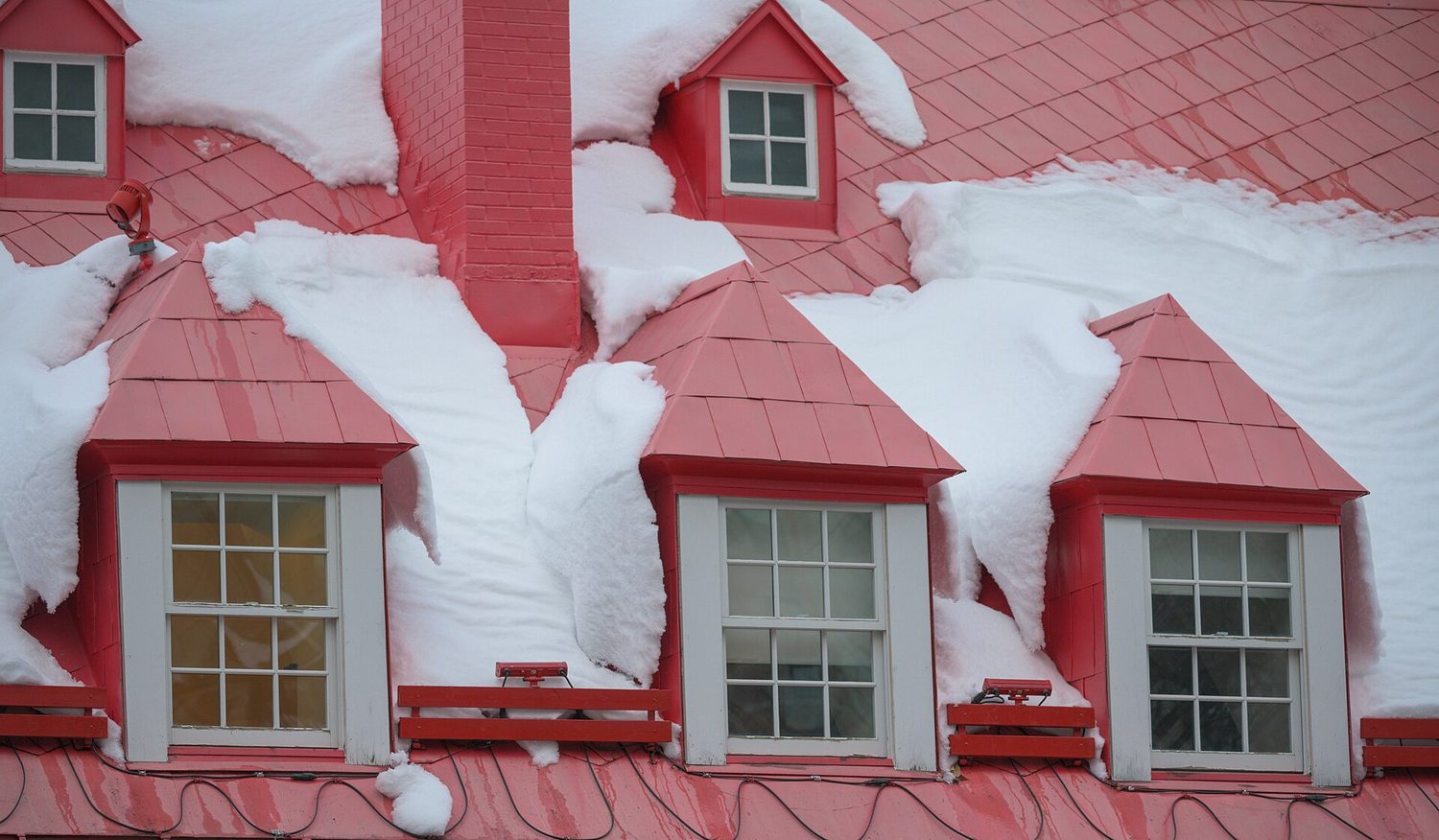
Three Real Ones
Less time at peak load
A roof that sheds carries its heaviest load for a shorter period than one holding snow from December to March. That is a genuine benefit — and it does not change what your framing was designed for, and it is not a substitute for a structural assessment on a building you have doubts about.
Smaller ice dams
Snow that has left the roof cannot melt on it. Less fuel means smaller dams. It does not prevent them — the cause is heat escaping into the roof assembly, and that is untouched by the covering. The full explanation is here.
Less freeze-thaw damage to the roof itself
Snow and ice sitting on a roof all winter, freezing and thawing repeatedly, is what ages asphalt fastest. A roof that sheds spends less of the winter under that cycle, and metal is unbothered by it in any case.
Where the Snow Lands
A roof's worth of snow releasing at once is heavy and fast. It can injure somebody, flatten planting, bend a railing, damage a propane tank or an outdoor unit, block a doorway, or land on a neighbour's drive. On a tight lot — Alton Bay frontage, Franklin village, Ashland — that last one is a real problem rather than a hypothetical.
Snow guards go wherever that matters. Above entrances and walkways, over decks and patios, above tanks and equipment, at gable ends overhanging a boundary.
| Type | How it works | Suits |
|---|---|---|
| Continuous bar systems | Rails running across the slope, clamped to the seams, holding the pack | Standing seam, where a clean line matters; most residential work |
| Individual pad guards | Small cleats distributed across the field in a pattern | Lighter duty, and roofs where a bar would be visually intrusive |
| Fence-style systems | Multiple rails, heavier duty | High snow loads and long slopes above something critical |
On standing seam, guards clamp to the seams with no penetrations — the same property that makes it the best roof for solar. Budget roughly $1–$3 per square foot of protected area.
Retention is not all-or-nothing. You do not need guards across a whole roof out of habit. You need them above the things that matter. An open field elevation with nothing beneath the eave but lawn needs none, and we will say so rather than sell you the perimeter.
Questions
Will snow damage the panels as it slides?
Properly installed panels, no. What suffers is anything the sliding snow catches on — badly fitted vents, poorly designed snow guards, gutters mounted without allowance for the load, and satellite dishes. Anything on a metal roof needs to be installed in the knowledge that a snowpack will one day move past it.
What about the gutters?
A sliding load will take an ordinary gutter off a fascia. Heavier hangers, correct positioning relative to the eave so the snow passes over rather than into it, and retention above anything you want to keep. Worth having the roofer and the gutter installer coordinate rather than sequencing them blindly.
Does roof pitch change how it sheds?
Considerably. Steeper roofs shed earlier and more readily; shallow ones hold snow longer and may not clear at all in a cold spell. Aspect matters too — a north-facing slope that sees no sun from December to March behaves quite differently from the south side of the same house.
Can I stop it sliding entirely?
Retention systems are designed to hold the pack in place so it melts and releases gradually rather than all at once — so yes, in effect, where that is what you want. The trade-off is that you are choosing to keep the snow on the roof, which brings back some of what shedding was doing for you. It is a deliberate decision, not a default.